When Love Hurts in Patterns: Understanding the Cycle of Abuse
Most people that come to therapy don’t come in saying, “I’m in an abusive relationship.”
They come in saying, “Something feels wrong, but I can’t explain why.”
Often, there’s a lot of minimizing and second-guessing. People compare their experience to “worse” situations or tell themselves they’re being too sensitive. That makes sense, abuse doesn’t always begin with one big, obvious wound. More often, it’s a death by a thousand cuts.
Sometimes the harm is overt and easy to name. Other times it’s covert and subtle. It might look like demeaning comments disguised as jokes, shifting rules and expectations, white lies, emotional withholding, contempt, or moments of fear followed by relief and closeness. Over time, these patterns can quietly alter how you see yourself, how you understand love, and what you come to believe you deserve in relationships.
If any of this feels familiar, you’re not alone, and you’re not imagining it.
Understanding Abuse as a Repeating Cycle
One of the biggest misconceptions about abuse is that it’s defined by constant cruelty or physical violence. In reality, abuse is better understood as a repeating relational pattern, a cycle that pulls people in and keeps them stuck.
Many abusive relationships follow a familiar rhythm, even if the details differ. Think “same text, different font.”
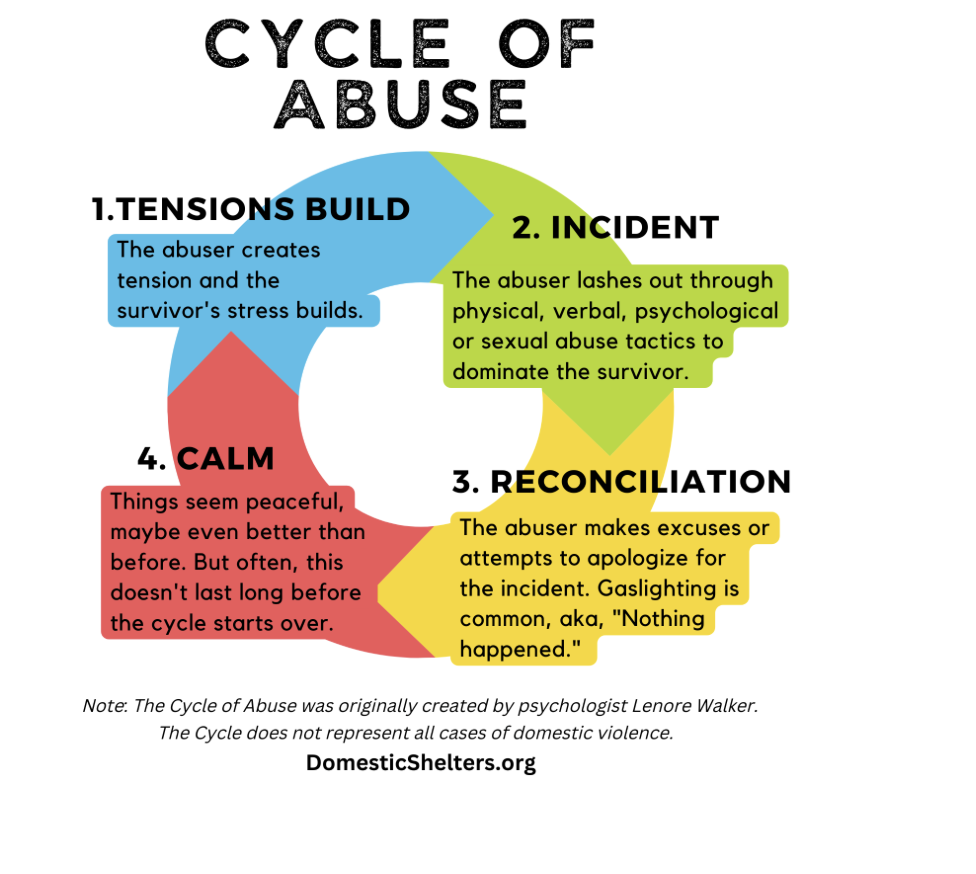
The Cycle of Abuse
1. Tension Building
Something feels off. You may notice yourself walking on eggshells, carefully choosing your words, monitoring your tone, or scanning for signs of irritation. You might shrink parts of yourself to keep the peace. Anxiety increases, your body stays on alert, and you may silence your own needs to avoid conflict.
2. Incident
The tension breaks. This could be an argument, an emotional outburst, manipulation, intimidation, or physical harm. Sometimes it’s not loud at all, it might be a cold withdrawal, a cutting remark, gaslighting, or a threat of abandonment. Even when there are no visible marks, the impact can be deeply destabilizing.
3. Reconciliation / Honeymoon
Apologies follow. There may be promises, affection, gifts, or explanations that make everything suddenly make sense. You might hear, “I didn’t mean it,” or “I’ll change,” or “You know how much I love you.” This phase can feel deeply connecting and relieving. Hope returns. Maybe this time it will be different.
4. Calm
Things settle. Life feels “normal” again. You breathe easier. And then, slowly, the tension begins to rebuild.
What makes this cycle so powerful isn’t just the pain, it’s the contrast. The relief that follows fear can create a strong emotional bond, even when the relationship itself is unsafe.
Why the Cycle Is So Hard to Leave
From a nervous system perspective, this cycle trains both the body and the brain. Research shows that when care and cruelty are mixed within the same relationship, attachment can actually strengthen. Studies on intermittent reinforcement suggest this pattern increases bonding significantly, because the person who causes the pain also becomes the source of comfort.
Fear followed by relief is a powerful conditioner. Over time, the body learns:
To stay alert
To normalize instability
To confuse intensity with intimacy
This helps explain why people can feel deeply attached to someone who hurts them—and deeply disoriented when the relationship ends. Leaving isn’t just a decision; it’s a nervous system shift.
Understanding the Aftereffects
Leaving the cycle doesn’t mean the effects disappear overnight.
Imagine being on a boat in stormy weather for months or years. Your body adapts. You learn how to brace yourself, anticipate the waves, and keep your balance. Eventually, the instability becomes familiar. It is the new normal.
Now imagine stepping onto solid ground.
The storm is over. The boat is gone. And yet, you still feel the rocking. Your body sways. You feel anxious, unsteady, unsure.
This doesn’t mean you’re broken.
It means your nervous system learned how to survive instability.
Common experiences after abusive relationships include:
Hypervigilance, even in safe relationships
Difficulty trusting calm or consistency
Guilt, grief, or self-doubt
Emotional numbness or delayed reactions
Wondering, “Why do I still feel this way if it’s over?”
Recovery is often about gently teaching the body that the ground is solid now.
Recovery takes time, not just emotionally, but physically and relationally. After living in an abusive cycle, safety and consistency can feel unfamiliar or even uncomfortable at first. This doesn’t mean something is wrong. It means your nervous system is adjusting to a new way of being. Relearning how to feel secure in healthy relationships happens gradually, with patience and support
Support and Resources for Those in Need
If you are experiencing abuse or need someone to talk to, you are not alone. Here are some confidential resources:
National Domestic Violence Hotline (U.S.): 1‑800‑799‑SAFE (7233) | thehotline.org
Crisis Text Line: Text HOME to 741741 (U.S. & Canada)
RAINN (Rape, Abuse & Incest National Network): 1‑800‑656‑4673 | rainn.org
LoveisRespect (Teen & Young Adult Dating Abuse): 1‑866‑331‑9474 | Text LOVEIS to 22522 | loveisrespect.org
If you are outside the U.S., you can find local hotlines here: https://findahelpline.com
Resources to Learn More
Dr. Ramani - The Narcissistic Relationship Cycle
Transforming Trauma Episode 61 Healing from Traumatic Love w/ Dr Nadine Macaluso
Book: Run Like Hell by Dr. Nadine Macaluso
Dr. Ramani - How narcissistic abuse follows you into future relationships
References
All material provided on this website is for informational purposes only. Direct consultation of a qualified provider should be sought for any specific questions or problems. Use of this website in no way constitutes professional service or advice.